I sometimes struggle to explain what I do. Not because I don’t know what it is, but because the words available to us are often either too small or too polished. “Coaching” does not describe it. “Therapy” does not describe it. “Spiritual work” is too vague, and often carries a language I don’t particularly want to use.
What I do is, at its heart, work of reconnection.
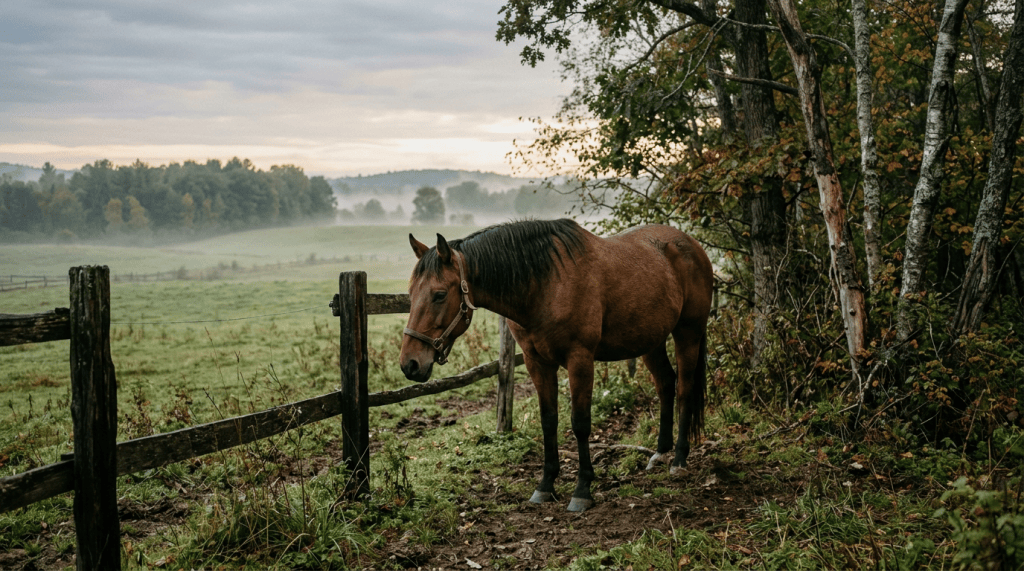
I work with people who are trying to find their way back into relationship: with their own bodies and inner lives, with their ancestors, with the land beneath their feet, with spirit, and with parts of their personal and cultural histories that have been forgotten, silenced, severed or pushed away. I work one-to-one and in groups, online and in person. Sometimes horses are part of the work, sometimes they are not. Sometimes we sit with them or lie down beside them; sometimes they participate more actively in constellation work or ancestral processes. Sometimes there is ceremony or ritual, sometimes there is simply a conversation in which something that has been difficult to name finally has enough space to become visible.
The deeper I go into healing, the less I believe that it is about becoming a better, more evolved or more spiritual version of ourselves. Increasingly, I think it has something to do with becoming right-sized again: right-sized in relation to other human beings, to animals, to the land, to our ancestors, to death, to mystery, and to the things we know as well as the things we do not know.
That is not a process that happens quickly. In many ways, it takes a lifetime, and perhaps more than one.
I have also become increasingly suspicious of the idea that healing anything like a linear journey.
There is a particular story of transformation that is very deeply embedded in our culture: the individual leaves home, enters the unknown, faces the monster, finds the treasure and returns transformed. It is a powerful story, but it is also a very particular story of awakening. It is individual, directional and heroic, and I have come to see how much of that image reflects a masculine understanding of what it means to find one’s way through the unknown.
My experience has been much more feminine than that.
The feminine journey, as I have come to know it, is often circular, bodily, relational and chaotic. It does not necessarily move forward in a straight line. It can take us underground and back again. It can involve birth and death, grief and rage, sexuality and shame, deep silence, sudden revelation and long periods in which nothing seems to make sense. It can ask us to surrender the idea that we are in control of the process at all.
That wildness is not something I want to hide from.
Engaging with spirit for real is wild. It can be beautiful, intimate and profoundly healing, but it can also be disorienting, demanding and unpredictable. It can bring us into contact not only with love, belonging and ancestral gifts, but with grief that has travelled through generations, with histories of oppression and violence, with things that were never given a place in ordinary family narratives.
This is part of why I take the work seriously.
I do not believe that every difficult experience is an initiation, and I do not think every crisis needs to be given a spiritual meaning. Sometimes pain is simply pain. Sometimes a person needs psychological or medical support, medication, sleep, food, a safe home, a clear boundary, or distance from a situation that is harming them. Sometimes the most important thing we can do is not open further into the unseen world, but become more grounded in this physical one: to eat, sleep, breathe, walk, work with our hands, be with safe people, tend to the body and remember where we are.
This is particularly important when working with spirit.
I am not a psychotherapist, and I am not a trauma specialist. I have lived through significant trauma myself and have learned a great deal through my own healing journey, as well as through training, practice, teachers and years of experience accompanying other people. But I do not want to present that experience as a qualification that I do not have.
This work was one of the things that changed the direction of my own life most profoundly, and I have seen its potential for transformation again and again. Precisely for that reason, I believe it needs to be approached with care. In an acute psychotic state, severe personal disorientation, acute retraumatization or other situations in which a person is not sufficiently grounded in ordinary reality, engaging more deeply with spirit can sometimes become more overwhelming rather than more healing. There are moments in life when the work is to come back to the earth, to the body and to ordinary human support, and there are moments when the first task is simply to establish safety and get out of a harmful situation.
Knowing that difference is part of my responsibility.
For me, boundaries are therefore not an optional addition to spiritual work. They are one of its foundations. Before engaging with ancestors or other spiritual realities, I want there to be a sufficiently clear sense of personal space, agency and safety. Can you feel your body? Can you say no? Can you recognize what belongs to you and what does not? Can you close something when you need to? Is your space your own?
And I do want to speak plainly about something else that is part of my understanding of the spiritual world: evil exists. Just as human beings are capable of cruelty, exploitation and destruction, I understand the spiritual realm to contain forces that are not benevolent either. I do not think this needs to become a source of fear, and I certainly do not believe that we need to seek them out, evoke them or make them larger through our attention. Quite the opposite. We do not invite harmful forces into the work. We maintain boundaries, we pay attention, and we take spiritual safety seriously.
There are things that can be encountered that are too powerful, too specific or simply beyond what I and the people I work with are trained or equipped to handle. Having seen a fair amount does not mean that I believe I can handle everything. There are situations in which the most responsible thing I can do is stop and refer someone to a colleague with the appropriate experience. I am fortunate to have a network of practitioners whose knowledge is different from mine and whom I can trust. I don’t see that as a limitation of the work. I see it as part of practicing it with integrity.
My own path into this work was not something I planned.
I have a master’s degree in sociology and come from a culture in which the things I now work with were largely absent, or were treated as irrational, primitive, private or embarrassing. Having spirit contact and sensations of dimensional shifts throughout my childhood, then, at one point in my life, I was suddenly and intensely exposed to what I can only describe as the other side. I did not have a framework for what was happening. I had no elders who could guide me through it, no living cultural container that knew how to hold the experiences I was having, and no ancestral tradition I could consciously turn toward.
It was a complete breakdown, but it was also an initiation, although I only came to understand that much later.
There was a great deal of suffering and confusion in the years that followed. I discovered heavy early childhood trauma and began to understand that what was happening to me could not be separated from the history of my own body and family. I had to find my way through much of it myself, and I got things wrong along the way. I misunderstood experiences, I lacked language, and I had no simple map to follow.
Eventually, though, something began to come together.
I started to see that what I had experienced was not only about me. It was connected to ancestry, culture, systems, trauma, land, belonging and the loss of relationship with things that human beings have known how to relate to for a very long time.
That realization changed the direction of my life.
I began to follow the calls that came from it, not toward becoming special, but toward becoming more connected.
That distinction has remained important to me.
Ancestral healing, as I practice it, is not about idealizing the dead. Some of the dead are not well. Our ancestors were not all wise or kind, and they were not all victims. They harmed each other. They participated in systems of domination. They carried their own wounds and passed some of those wounds on. They were sometimes perpetrators, sometimes victims, and very often both.
We inherit more than names and family stories. We inherit relationships, patterns, silences, fears, capacities, unfinished things and histories that may continue to shape the living even when nobody consciously remembers them.
So in an ancestral lineage healing process, I guide a person toward a safe and actual relationship with their own ancestors. I am not there to tell them what their ancestors think or what their life should be. I accompany the process and provide structure and guidance. The client establishes contact with an ancestral guide who is well enough in spirit to take on the healing of the lineage. Within the practice, the lineage is then held in what we call a healing container, supported by benevolent spiritual forces while it receives what is needed for an initial stabilization and movement toward healing.
We return to the process over several sessions. Information can emerge about the lineage, its burdens and repeating patterns, particular histories and lifetimes, and also the gifts that have been carried forward. The process can bring grief, recognition, changes in relationships, unexpected understandings and sometimes profound blessings. It can also be quiet. There is no fixed timetable. Some lineages move through the process relatively quickly; others take much longer, sometimes months or years. I have come to understand that this is not something that can simply be forced into a schedule. It has its own pace, and that pace is often connected to the relationship between the living and the dead.
As the ancestors move toward a more healed state, they become what we call ancestralized: less defined by what they could not resolve and more able to stand in a healthy relationship with the living as ancestors. I do not see myself as making that happen. I am there to accompany the relationship and help create the conditions in which it can unfold.
The horses have taught me a great deal about this kind of accompaniment.
They have an extraordinary way of leading without dominating. They don’t need to convince anyone of their authority. They have presence, boundaries and a very immediate relationship with what is happening around them. They can be gentle and uncompromising at the same time.
One teacher once described my way of working as “loving authority”, and I have thought about those words ever since. I don’t want authority over people. I do, however, want to be able to lead. I want to be able to hold the structure when someone else cannot, to notice when something has become too much, to say no when no is needed, and to remain steady when another person is moving through something intense.
For me, that is a very different kind of power. It is power that does not need power-over.
The horses embody that distinction beautifully.
When they are part of ancestral work, they may simply hold the space. Their presence can help ground emotions and support regulation. They respond to changes in the person and, within the spiritual framework of the work, sometimes respond to spiritual contact as well, making something that is otherwise invisible more tangible. Their presence can make the process intimate, physical and calm.
But the horse is not a prop and not a magical instrument. The horse is a living being with its own boundaries, perception and agency, and the relationship with the horse is itself part of what makes the work possible.
This is also why my professional life and my daily life have become increasingly difficult for me to separate.
I live in the countryside with animals. I milk. I make cheese. I train with horses. I make fires, tend the land, work with plants, cook, practice ritual and spend time learning about the old traditions of the place where I live.
None of this makes me more authentic than someone who lives in a city. It simply means that these are the conditions in which I have chosen to practice my own relationship with life.
I am interested in rewilding, but not as an aesthetic. I am interested in what happens when we actually learn what grows around us, how to make a fire again, how to make food, how to work with animals, how to read a landscape, sense, and how to stay somewhere long enough to become accountable to it.
I am interested in recovering ancestral European relationships with land, season, spirit, craft and ritual. But I don’t want to invent an untouched European past that never existed. Much was lost, much was deliberately suppressed or demonized, much was transformed beyond recognition, and much of what existed was not innocent or harmonious either. Our ancestors were human beings, with all the beauty and violence that entails.
So the task, as I understand it, is not to recreate some imagined golden age. It is to find out what can be recovered, what can be repaired, what needs to be relinquished, and what new relationships might become possible now.
That is where ancestral work also becomes cultural work.
I see the loss of relationship as one of the deep wounds of our time. We have separated ourselves from land, from ancestry, from elders, from the more-than-human world, from our bodies and from one another, while building systems that normalize forms of domination that would once have been unthinkable.
In the work with the ancestors, we have come to recognize six cultural patterns that repeatedly appear underneath personal and collective suffering: human supremacy, exploitative economic systems and the hoarding of resources, patriarchy and misogyny, colonialism and the theft of land and culture, racism and the fiction of human racial hierarchy, and ideological supremacy—the conviction that one’s own worldview must be imposed as the correct one.
These are not simply political ideas that I disagree with. They have histories, and they live in institutions, families, bodies and relationships. They also live in the culture that formed me.
So I cannot approach this work as though I am standing outside the problem.
I am inside it.
If I speak about decolonization, I have to ask what that actually requires of me. What have I inherited? What do I benefit from? What have I been taught to consider normal? What relationships have been broken? What was taken? What has been silenced? What needs to be returned, repaired, shared or relinquished?
I don’t believe these are questions that can be answered once and then put away. They are practices. They require humility, action, the willingness to be wrong, and the capacity to stay in relationship when things become uncomfortable.
This is also why I don’t think personal healing can be separated entirely from the larger world.
Personal healing matters enormously. A person needs enough safety, stability and connection to themselves before they can begin to take on larger questions. But once there is some ground beneath the feet, I believe there is another question waiting: what do we do with what we have healed?
Do we simply feel better as individuals, or does our healing change the way we participate in our families, communities and cultures?
For me, the work eventually has to move in that direction.
Toward relationship.
Toward responsibility.
Toward repair.
My work and the way I live have therefore become part of the same practice. I am trying to walk what I talk about, although I don’t pretend to do that perfectly.
If I speak about relationship, how do I relate?
If I speak about the land, how do I live on it?
If I speak about ancestors, am I willing to face what they did as well as what they gave me?
If I speak about healing, can I meet my own wounds?
If I speak about community, am I willing to be accountable to other people?
If I speak about power, am I willing to examine my own?
These questions matter to me more than appearing coherent or spiritually accomplished.
I am suspicious of presentation, certainty and spiritual hierarchy. I am suspicious of myself whenever I become too impressed with myself. There is a great deal in this field that can become performance. It is easy to speak beautifully about healing, ancestors, ceremony, feminine wisdom and connection while remaining remarkably disconnected from the actual demands of relationship.
So I want my work to remain close to the ordinary.
To the body.
To the animals.
To the land.
To food and fire.
To grief.
To boundaries.
To difficult conversations.
To the willingness to say, “I don’t know.”
The people I most want to work with are not necessarily people who have the right beliefs or the right vocabulary. They are people who are willing to be sincere, to feel, to question, to listen, to take responsibility and to enter relationship.
I don’t need someone to agree with everything I believe. I need them to be willing to meet what is actually there.
The work can be intimate. It asks for trust, but also for boundaries; vulnerability, but not performance; openness, but also discernment. Sometimes it will transform a person’s understanding of their family or their own life. Sometimes it will bring grief before it brings relief. Sometimes it will ask them to change something concrete in the way they live.
I don’t promise that the work will make life easier.
In some ways, genuine reconnection may make us more aware of what we had previously been able to ignore.
But I do believe it can make life more alive.
More relational.
More rooted.
More honest.
Perhaps that is what I have been trying to find all along: not a way out of being human, and not a way to become more special, but a way further into being human. A way of becoming less isolated, less inflated, less afraid of mystery and more capable of relationship. A way of remembering that we belong to something larger than ourselves without losing our own discernment and responsibility within it.
I don’t know where this work ultimately leads.
I know only that I have been called to keep walking, to keep learning, to keep questioning myself, and to keep trying to live in a way that is congruent with what I ask of others.


