STILL
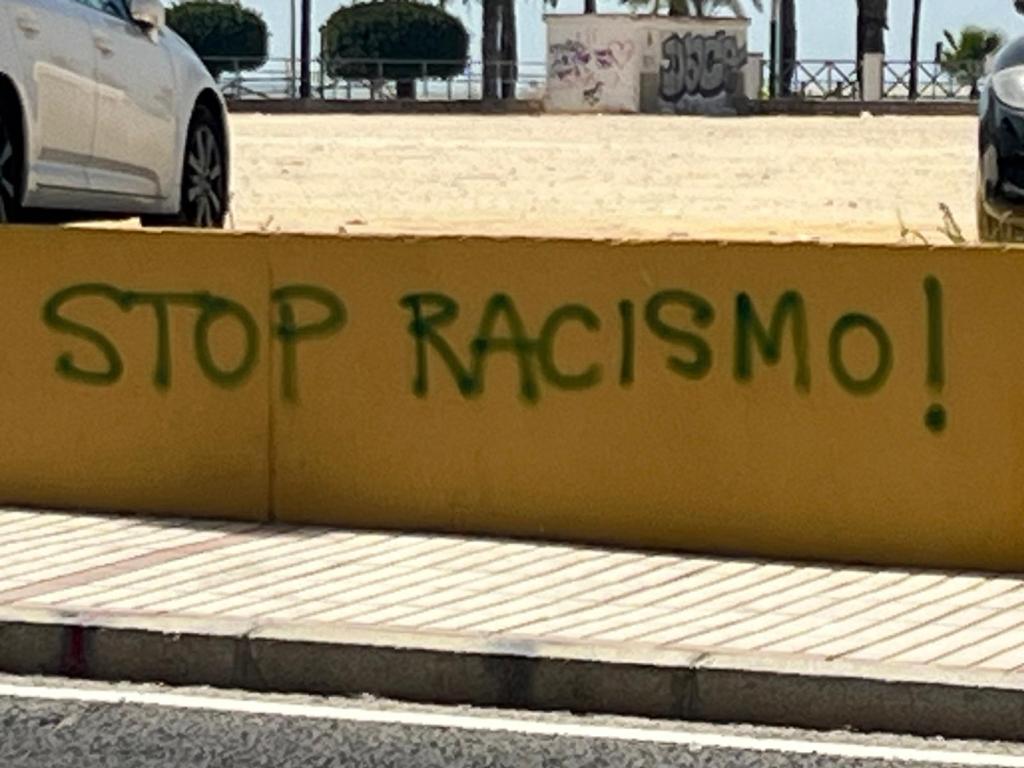
Last night I was lying in bed when, suddenly, I felt afraid. Not the small, everyday kind of fear. Not the fear of something that might happen to me personally. A much bigger fear. The fear that people are becoming blind again. That people are taking to the streets again to demonstrate against other people. That we are once again beginning to separate human beings from one another, to divide them into groups, to assign different values to their lives – until some people somehow become less human than others. Systematic dehumanisation.
I feel like I recognise the old patterns. The same mechanisms. The same simplifications. The same enemy images. The same language that creates fear and turns people against one another. On Wednesday, thousands of people took to the streets across Spain to show their support for Ceuta and to protest against the government’s migration policies. In Ceuta itself, tens of thousands took part.
What do we do with our fear? And who benefits when we are taught to direct that fear towards other human beings?
Because that is where things become dangerous: when people start believing that the people arriving are the problem – rather than the political decisions, structures, power relations and systems that create and manage these situations. Separation as strategy. Divide people. Create fear. Name an enemy. Repeat the message. And eventually, the image of the enemy begins to feel like a fact. People who are afraid are easier to convince. And people who are different are easier to turn into enemies. The perfect service to any system that wants to preserve its power.
I am afraid of this shift. Of this change in the energy. What if this gets out of control? What if we are moving in the wrong direction again? To the right. I keep asking myself: What is happening here? Have we forgotten? The machine is still working exactly as dangerously as it always has. And I have not only seen this since yesterday. I see it all the time.
But I am also afraid of my own fear. Because sometimes I wonder whether fear itself can become part of what I am afraid of. Whether, through my fear, I enter a collective field of fear. Whether I might be feeding the very reality I am afraid of.
My ancestors tell me something else: Feeling fear, knowing fear, is not the problem. Ignoring it is. Because what we do not consciously acknowledge does not disappear. It continues to act – in the hidden places, in the unconscious, in the body, in our decisions, in our relationships, in our politics.
Yesterday, a friend said to me: We live here in “Andalucía baja” – in deep Andalusia. And he does not mean only a place. Maybe he means a time. The dictatorship ended here not so long ago. Its traces have not disappeared – despite the Pacto del Olvido, the Pact of Forgetting. Separation is everywhere. So is fear. And inside me, very old, very primal fears are being triggered. Fears I have known for years. And still – or perhaps precisely because of that – I have to look at them again: the fear of not belonging, the fear of being different. “Giri” – a colloquial Spanish word for foreigners, particularly those perceived as coming from elsewhere in Europe. Extranjero. Stranger. Outsider. A woman who lives alone. A woman with her own opinions, and the courage to speak them. A woman who practises agriculture in an animist way. A woman who does not fit easily into the forms that have been prescribed for her.
The air is getting thinner. And the atmosphere is getting hotter. I no longer have a house. My animals no longer have land on which to live. My values have become a target. My existence has become a projection screen for other people’s fears and assumptions. And for others among us, it looks very different indeed. In Ceuta, people are becoming pawns in a deeply political and geopolitical crisis. People – including many minors – are being turned into symbols of something much bigger than themselves.
And that is where one of the greatest dangers lies: when human beings are no longer seen as human beings, but as “migration”, as “invasion”, as “threat”, as a number, a mass, a problem. Then it becomes possible to talk about people without actually talking about them. Without knowing their names. Without hearing their stories. Without seeing their fear. Without recognising their dignity. The current events in Ceuta reveal this tension with frightening clarity. Migrants, and particularly unaccompanied minors, are living in precarious conditions while public debate is increasingly shaped by words such as “invasion” and “expulsion”.
This is not personal. At least, not only. It is collective. Global. Cultural. Spiritual. Institutional. And above all: systemic. The person who fights against their neighbour is not necessarily resisting the system. Sometimes they are fulfilling its logic. When we fight each other, we stop looking upwards. When we fear each other, we stop asking who is making the decisions. When we dehumanise each other, we no longer have to change the structures. None of this is new. History is full of it. Racism and dehumanisation do not simply appear out of nowhere. They are produced and normalised through language, institutions, political decisions, media, power and repetition.
And that is exactly why one thing frightens me most: that it still works. That we can still be persuaded to see other human beings as threats. That we can still be made to believe that our neighbour is our enemy. That we can still be made to believe that our safety requires someone else to have less of it. That we can still be made to believe that belonging has to come at the expense of someone else’s belonging.
So what is left to do? I don’t know. I only know that racism and dehumanisation will not disappear as long as we refuse to transform the systems, structures and ways of thinking that keep reproducing them. And until then? I will stay with what I know. With the sacred values held by my faith and by my love for human beings and for this Earth. With dignity. With humility. With equality. With the right of every living being to life and safety. With belonging. With the understanding that no human being becomes less human because they were born differently, believe differently, look different, love differently, live differently, or seek safety somewhere else.
Still.
On Sunday, the annual village festival begins in my village here in “Andalucía baja”. The Virgen de la Luz will be carried from her chapel into the village, accompanied by around 300 horses and hundreds of people, and celebrated there. I don’t really feel like celebrating right now. And yet I will be there. This tradition asks an enormous contradiction of me: to stand between a male-dominated, nationalist, ideologically controlled and aristocratically shaped idea of superiority – and the sacred humility and devotion of the Virgen de la Luz. The Virgen who brings light and rain, who blesses and protects Mother Earth, who accompanies the harvest, who blesses the animals with health, who accompanies the farmers of this region, and who has supported me every day for the past six years in my spiritual practice. Gracias, Virgen de la Luz.
This tradition carries its own history. Women were only officially allowed to participate in the event from 2001 onwards. Not because the structures suddenly changed by themselves, but because women resisted actual attacks and participated anyway. Giris came much later. There is a story told here- actually a bridge named «the bridge of the English lady», about a woman from England who, years ago, followed the procession on horseback – keeping enough distance to accompany the Virgen without officially becoming part of the procession itself. That too is history. That too is separation. That too is resistance.
Perhaps this is where our task lies. Not in having no fear. Not in pretending that everything is fine. Not in separating myself from people who think differently from me. But in remaining awake. In feeling fear without allowing it to lead. In feeling anger without becoming dehumanising myself. In knowing history without accepting it as an unchangeable destiny. And in asking, again and again: Who is being turned into the enemy? Who benefits from it? Whose humanity is being made invisible? What fear is being sold to us? And what happens if we refuse to buy it?
Maybe that is what “still” means.
Still afraid. Still angry. Still carrying history. Still facing power. Still living with separation. Still refusing to believe that we do not belong together.
Let us do what we can. Let us keep our eyes open. Let us refuse to be turned against one another. Let us refuse to be dehumanised – and to dehumanise others. Let us look more closely before we believe what we are being told. And let us learn to distinguish between what frightens us – and what is actually dangerous.
Because perhaps the greatest danger is not the person standing next to us. Perhaps it is the moment when we forget that they are human.
Still.
I choose connection.
I choose dignity.
I choose life.
I choose the Earth.
I choose all of us.


