The Wound of Separation: Supremacy, Cultural Harm, and the Work of Belonging
The lineage work we are doing may appear, at first, to be primarily about family and personal healing. We look at what was carried by our parents and grandparents, at what happened in the lives of those who came before us, at what was lost, survived, silenced, repeated, or never given the opportunity to heal.
But a lineage has never existed outside of culture.
Our ancestors did not only inherit family stories. They inherited worlds. They inherited ideas about who mattered, what mattered, whose lives were valuable, what belonged to whom, what could be taken, what could be controlled, what could be believed, whose bodies could be desired or disciplined, whose land could be occupied, whose suffering could be ignored, and which ways of knowing were considered legitimate.
The personal is therefore inherently cultural.
And the cultural is carried personally.
We can begin lineage work with our own wellbeing—with the body, the nervous system, our relationships, our capacity to feel safe enough to look. We need that groundwork. But as our capacity grows, another layer becomes visible: the cultural pain running through our lineages and through the world we inhabit.
It is useful to have a framework for recognizing it.
One way of beginning to name the problem is through the idea of supremacy.
At its most basic, supremacy is the belief—or embodied assumption—that one being, group, way of living, worldview, identity, species, or form of existence is entitled to stand above another.
It is the energetic and cultural logic of:
We are better than you.
Our nation is better.
Our religion is better.
Our ancestors are better.
Our culture is better.
Our way of loving is better.
Our bodies are better.
Our worldview is correct.
Our species is more important.
Our people deserve more.
Supremacy can exist as an attitude inside an individual. But it can also become organized into institutions, economies, laws, traditions, family systems, identities, and entire cultures.
That distinction matters.
Because cultural harm is not only something one person does to another. A supremacist attitude can become a system. A system can shape a family. A family can shape a child. And what was once systemic can eventually feel simply like “the way things are.”
Perhaps the most useful way to understand this is not as six completely separate problems, but as several expressions of a recurring cultural logic.
I think of six major forms of cultural disruption.
They all show up in our lineages, in different forms and to different degrees. And within each of us, we may carry experiences of being harmed, experiences of participating in harm, and adaptations to both. We need the full spectrum.
The point is not to divide humanity into victims and perpetrators forever.
The point is to become capable of recognizing what has been carried.
These patterns are toxins.
And toxins can become medicine.
When we can recognize a pattern, feel what it has cost, understand how it was transmitted, and interrupt its reproduction, we become participants in cultural transformation.
1. Human Supremacy
The first form is human supremacy: the assumption that our species is fundamentally above the rest of life.
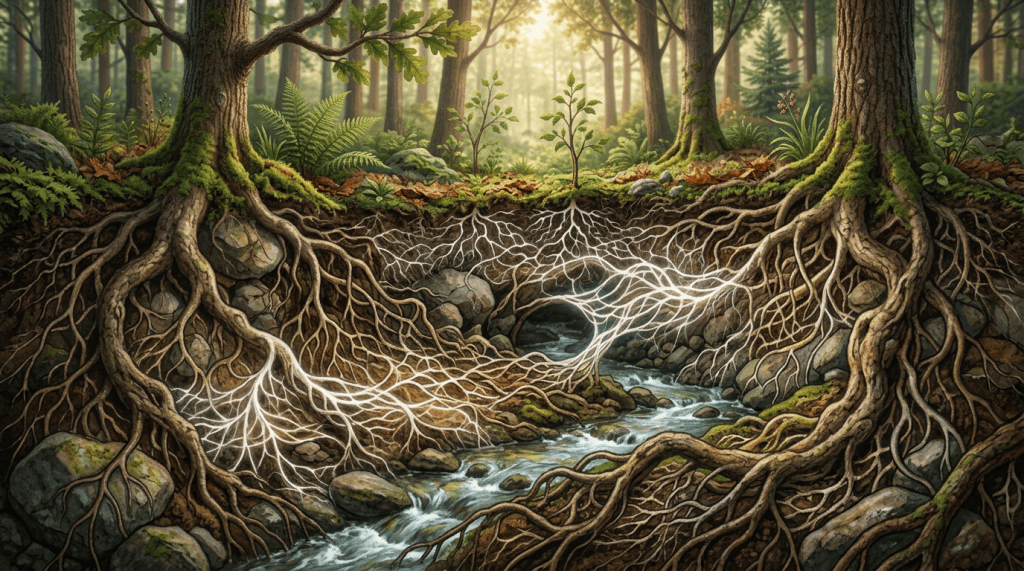
For many people, this is difficult even to perceive because it is so deeply normalized. We speak of “nature” as though humans were somehow outside of it. We speak of animals as resources. Land becomes property. Forests become timber. Rivers become water supplies. Other beings become food, commodities, experiments, entertainment, or obstacles.
From an animist perspective, this represents a profound shift.
At some point in many lineages, people moved—or were forced to move—away from a worldview in which the world was experienced as alive, relational, and inhabited by beings with whom humans existed in reciprocal relationship.
The medicine is not to make humans worthless.
It is to remember kinship.
To remember that we are not separate from the living world.
We are not humans who happen to live on Earth.
We are beings of Earth.
The movement is therefore not from human superiority to human inferiority, but from domination to reciprocity.
2. Economic Supremacy: Extraction, Accumulation, and Hoarding
A second form appears in our relationship with resources.
We can organize economies around the assumption that accumulation is good even when accumulation for some depends upon deprivation for others.
We can create systems in which having vastly more than we need is considered success while other people lack food, housing, security, time, or access to basic resources.
There is a strange collective illusion here:
That I can have far more than others while they have far less—and that this is somehow an acceptable state of the world.
Extraction turns relationship into transaction.
Hoarding turns abundance into possession.
Competition turns another person’s wellbeing into something that can feel threatening to our own.
The medicine is not simply the redistribution of money. It is a deeper remembering of sufficiency, reciprocity, stewardship, and sharing.
The question changes from:
How much can I accumulate?
to:
What is enough, and how do we live well together?
An economy is ultimately a way of organizing relationship.
What does it say about us if our systems require endless accumulation in a world of finite resources?
What does it do to the human psyche to spend our lives proving our worth through productivity and possession?
These questions lead directly into another form of supremacy.
3. Gender, Sexual, and Bodily Supremacy
Patriarchy is one expression of the belief that some bodies and ways of being are more legitimate, powerful, valuable, or desirable than others.
But this extends beyond sexism.
It includes misogyny, discrimination based on sexual orientation, repression and shame around sexuality, rigid ideas about gender, policing of gender expression, and the assumption that there is one correct way for a body to be.
It can also appear in the capitalist valuation of the body itself.
A body is considered valuable insofar as it is productive.
Young bodies are valued differently from old bodies. Able bodies differently from disabled bodies. Conventionally attractive bodies differently from bodies that do not conform to dominant standards.
We begin to evaluate human beings according to their usefulness.
The body becomes a function.
The medicine is not simply reversing who occupies the top of the hierarchy.
It is remembering bodily dignity and plurality.
It is making room for queer lives, celebrating and uplifting diverse bodies, different abilities, different ages, different forms of gender and sexual expression, and forms of existence that do not need to justify themselves through productivity.
It is remembering that a human being does not have to be useful in order to be worthy.
4. Colonial Supremacy
Colonialism makes supremacy explicit in its relationship to land and peoples.
It is the logic that says:
We can arrive somewhere and claim what was already held in relationship by someone else.
Land becomes territory. Territory becomes property. People become obstacles. Culture becomes something that can be erased, appropriated, controlled, or replaced.
Colonialism is not simply a historical event that ended.
Its consequences continue through land ownership, political structures, economic arrangements, cultural erasure, displacement, and the continuing loss of sovereignty.
Its underlying wound is relational.
A relationship to land is replaced by ownership of land.
The medicine therefore includes restitution, sovereignty, restoration of resources, cultural continuity, and movements such as Land Back.
But beneath these political forms is a deeper remembering:
Land is not merely something we own. It is something we are in relationship with.
5. Racial Supremacy
Racism is another expression of the human tendency to turn difference into hierarchy.
The idea that humanity is divided into biologically distinct races, arranged in a hierarchy of value, is historically constructed. Yet the consequences of that construction have been extraordinarily real.
White supremacy and European supremacy created systems in which certain people were positioned as normative, civilized, intelligent, beautiful, rational, or fully human, while others were positioned as inferior.
Ancestral supremacy itself is not new. Human groups have long imagined themselves to be superior to others.
But modern racial categories provided a particularly powerful system for organizing those hierarchies.
The medicine is not colorblindness.
It is not pretending that difference does not exist.
It is proactively celebrating ancestral diversity while telling the truth about hierarchy and repairing the structures through which racism continues to operate.
Difference does not need to become hierarchy.
We can see one another more clearly without needing one another to be less.
6. Ideological Supremacy
The sixth form may be the most subtle because it can appear in almost any belief system.
It is the attitude:
My view is the correct one.
My religion.
My politics.
My philosophy.
My science.
My spirituality.
My tradition.
My understanding of history.
Ideological supremacy turns a worldview into a weapon.
It does not merely say, “This is what I see.”
It says:
If you see something else, you are wrong, inferior, dangerous, ignorant, or illegitimate.
Fundamentalism can emerge anywhere.
The medicine is not to believe nothing.
It is epistemic humility.
We can have convictions without requiring domination.
We can have values without becoming rigid.
We can discern without dehumanizing.
We can say, “This is what I believe,” without needing to say, “Therefore you must become me.”
The Deeper Pattern: Separation
These six forms of supremacy are not identical, and their histories are not interchangeable.
But they share a recurring mechanism.
Supremacy creates separation.
It divides the world into above and below, worthy and unworthy, civilized and primitive, productive and useless, human and nonhuman, us and them, correct and incorrect.
Once separation is established, domination becomes easier.
If another being is truly separate from me, their suffering becomes easier to ignore.
If another person belongs to an inferior category, their deprivation can become acceptable.
If another culture is considered less developed, taking its land can be justified.
If another body is considered less valuable, excluding it can feel natural.
If another worldview is considered dangerous, silencing it can feel righteous.
Separation makes domination possible.
And domination produces trauma.
That trauma does not simply disappear when the original event ends.
It enters bodies, families, relationships, stories, identities, institutions, and nervous systems.
It becomes part of what is inherited.
The Hidden Consequence: Loneliness
But as I followed this pattern more deeply, another consequence began to stand out.
Perhaps one of the deepest wounds produced by these systems is loneliness.
Not simply being alone.
Something more profound.
A sense of being fundamentally separate.
People can be surrounded by hundreds of others and still experience an almost unbearable isolation.
They can have families, friendships, partners, communities, careers, social media, and full calendars—and still carry somewhere inside themselves the feeling:
I am alone here.
Perhaps this loneliness is one of the hidden consequences of cultural separation.
Supremacist systems organize the world through hierarchy and separation. Repeated over generations, this can become alienation: from land, from the body, from community, from ancestry, from meaningful work, from other species, from our own vulnerability, and from one another.
Alienation is then experienced personally as loneliness.
This is why the problem cannot be understood only as an individual psychological problem.
If the world repeatedly teaches us that we are autonomous individuals competing for scarce resources, that vulnerability is weakness, that dependence is failure, that our worth is measured through productivity, that difference is threatening, and that security comes through accumulation and control, then loneliness is not an accidental side effect.
It becomes structurally predictable.
And loneliness can make us vulnerable to the very systems that produced it.
Because when we do not experience belonging, we may search for security elsewhere.
We may seek superiority.
We may seek rigid identity.
We may seek ideological certainty.
We may seek control.
We may seek accumulation.
We may seek belonging through exclusion.
There is a terrible paradox here:
Supremacy can become a substitute for belonging.
If I cannot experience the safety of being with you, perhaps I can experience the safety of being above you.
I am safe because I am above you.
But belonging offers an entirely different answer:
I am safe because I am with you.
These are two radically different ways of organizing a human life.
The Relational Self
Perhaps one of the most important things for humanity to remember is that we are not separate beings who happen to have relationships.
We are relational beings whose lives are constituted through relationship.
We become ourselves through relationship—with caregivers, families, ancestors, communities, land, culture, other species, and the larger living world.
This changes the meaning of healing.
Lineage healing is not only about healing what happened to our ancestors.
It can also be about learning to recognize which patterns of separation entered our lineages.
What relationships were broken?
What was lost?
What was forbidden?
Who had to be rejected in order to belong?
Who had to dominate in order to survive?
What forms of superiority were taught?
What forms of inferiority were endured?
What did our ancestors have to disconnect from in order to survive their world?
And what capacity for relationship is waiting to be restored?
This is where personal healing and cultural healing meet.
We can discover that something we experience as “my problem” may have a much longer history.
And we can also discover that what we heal personally can change what we reproduce culturally.
From Toxin to Medicine
The goal is not to create a world without difference, conflict, disagreement, or complexity.
Nor is it to replace one hierarchy with another.
The deeper task is to develop cultures in which difference does not require hierarchy, belonging does not require exclusion, security does not require domination, and abundance does not require someone else’s deprivation.
The medicines begin to reveal themselves.
Human supremacy becomes kinship with the more-than-human world.
Extraction becomes reciprocity and sufficiency.
Gender hierarchy becomes bodily dignity and plurality.
Colonial domination becomes sovereignty, restitution, and restored relationship with land.
Racism becomes truth, ancestral diversity, justice, and repair.
Ideological rigidity becomes humility, curiosity, and plural ways of knowing.
And underneath all of them is the same movement:
from separation toward relationship.
Not just from individual to collective, but from the isolated self to the relational self.
Not from certainty to believing nothing, but from certainty without domination to humility.
Not from wealth to poverty, but from endless accumulation to enough.
Not from hierarchy to chaos, but from domination to reciprocity.
The medicine is not simply the opposite ideology.
It is relationship restored.
The Work of Our Times
Perhaps this is why the work of lineage healing matters so much.
We are not only trying to understand where our pain came from.
We are learning to recognize the worlds that shaped the people who came before us—and the worlds that are still shaping us.
We are learning to hold the full spectrum within ourselves: the places where we were harmed, the places where we adapted, the places where we may have participated in harm, the places where we inherited privilege, the places where we inherited wounds, and the places where our ancestors carried wisdom that can help us now.
We do not need to condemn our ancestors in order to see clearly.
Nor do we need to idealize them.
We can become capable of telling the truth while remaining in relationship.
That may be one of the deepest forms of ancestral healing:
to stop reproducing what we inherited without having to reject the people from whom we inherited it.
We can stay connected to our people while looking honestly at the cultural troubles they lived inside.
We can say:
This happened.
This was carried.
This shaped us.
This harmed us.
This helped us survive.
And it does not have to continue through us.
Because cultural transformation does not begin somewhere far away from the human heart.
It begins wherever a pattern of domination is recognized and a different relationship becomes possible.
A child who is allowed to be fully themselves.
A body that is no longer treated as a machine.
A person who can receive without shame.
A community that shares rather than hoards.
A society that repairs rather than erases.
A human being who remembers that the forest is not merely a resource.
A person who can disagree without needing to destroy.
A culture that can encounter difference without turning it into hierarchy.
These may seem like small acts.
They are not.
They are rehearsals for another way of being human.
Perhaps the deepest remembering is this:
We belong to one another, and to the living world, before we belong to any hierarchy.
We are not separate beings who must earn our right to exist.
We do not need someone beneath us in order to know that we belong.
We do not need domination in order to be safe.
We do not need sameness in order to be connected.
And we do not need superiority in order to have dignity.
The great task may therefore not be to create a perfect culture.
It may be to remember how to belong without needing someone else to be beneath us.
That is the movement from supremacy to reciprocity.
From separation to relationship.
From alienation to belonging.
From inherited trauma to conscious participation.
And perhaps, ultimately, from loneliness back into the living web from which we were never truly separate.

 VIA REUNIDA