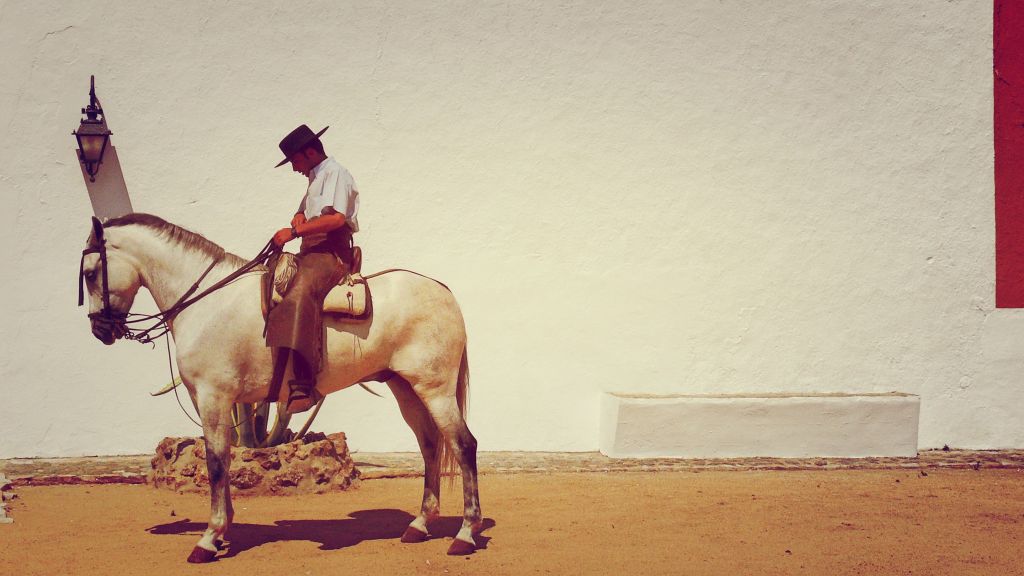
To understand Andalusia is, in many ways, to understand its relationship with the horse. Across the region, horses appear in festivals, religious pilgrimages, classical riding schools, cattle work, and family traditions. They are celebrated in paintings, music, literature, and public spectacle, often presented as symbols of beauty, nobility, and regional identity. Yet behind these familiar images lies a far more complex story—one that reveals how humans and horses have shaped one another over centuries.
The history of the Andalusian horse is frequently told as a story of refinement. Roman writers praised the horses of Hispania for their endurance and agility, while later Arab and Berber influences transformed breeding practices on the Iberian Peninsula. During the reign of the Catholic Monarchs, horse breeding became increasingly organised, producing animals that served military ambitions, royal prestige, and diplomatic exchange. The development of the Pura Raza Española (PRE) is therefore inseparable from the political history of Spain itself.
At the same time, this history invites us to ask whose story is being told. Narratives of selective breeding often celebrate purity, perfection, and human achievement. They rarely acknowledge that these ideals emerged through the systematic shaping of another living being according to human desires. Horses became symbols of power not through their own choosing but through relationships structured by ownership, utility, and representation. To recognise this does not diminish the extraordinary cultural significance of the Andalusian horse; rather, it allows us to see that admiration and control have often existed side by side.
This tension continues to characterise Andalusian equestrian culture today. Traditional riding disciplines such as Doma Vaquera emerged from the practical work of cattle herders, requiring exceptional trust, responsiveness, and mutual understanding between horse and rider. Classical dressage, preserved by institutions such as the Royal Andalusian School of Equestrian Art in Jerez de la Frontera, presents horsemanship as a refined artistic practice in which precision and elegance become forms of cultural expression. These traditions preserve invaluable knowledge about movement, balance, and communication, while also reflecting historical ideas about discipline, hierarchy, and mastery.
Beyond the riding arena, horses remain deeply woven into Andalusian social life. During the Romería del Rocío, pilgrims travel on horseback or in horse-drawn carriages, transforming the journey itself into a communal act of devotion. At the Feria de Abril in Seville and the Feria del Caballo in Jerez, horses move through streets filled with music, dance, and celebration, embodying a sense of continuity between past and present. Here, horses are not simply decorative elements; they are active participants in rituals through which communities remember who they are.
Yet these celebrations also reveal an enduring paradox. Horses are honoured, admired, and cared for with remarkable dedication, while simultaneously being expected to perform, represent, and fulfil human expectations. Their presence is often celebrated as cultural heritage, even as their own experiences remain largely absent from the narratives surrounding them. This paradox is not unique to Andalusia. It reflects a broader human tendency to value animals for what they symbolise rather than for who they are.
For this reason, the horse occupies a particularly revealing place within Andalusian culture. It stands at the intersection of history, politics, economy, aesthetics, spirituality, and everyday life. Studying the horse therefore becomes a way of studying human society itself: our ideas of beauty, our relationships with power, our capacity for cooperation, and the ways in which cultural traditions are continually created and reinterpreted.
One concept illustrates this especially well: versammlung, or collection. Within the classical tradition, collection is often described in technical terms as the horse’s ability to carry itself in balance. Yet at its deepest level, it is less a mechanical posture than a quality of relationship. Genuine collection cannot be produced through force alone. It emerges from attentiveness, patience, bodily awareness, and reciprocal trust. In this sense, the ideal of collection offers an alternative to understandings of horsemanship based solely on control. It suggests that true mastery lies not in domination but in the capacity to listen, respond, and move together.
Seen from this perspective, the horse is more than a cultural emblem or a product of successful breeding. It is a living presence whose history has unfolded alongside our own. The traditions of Andalusia demonstrate the remarkable depth of human–horse relationships, but they also invite critical reflection on how those relationships have been shaped by unequal structures of power. Between reverence and exploitation, partnership and possession, lies the ongoing challenge of imagining ways of being with horses that honour not only their cultural significance but also their existence as sentient beings with lives of their own.
Ultimately, the story of the horse in Andalusia is not simply about a celebrated breed or a regional tradition. It is about the kinds of relationships humans choose to cultivate with the more-than-human world. By looking closely at these relationships, we begin to understand that culture is never created by humans alone. It emerges through countless encounters between species, landscapes, histories, and shared lives. The horse has helped shape Andalusia for centuries; perhaps the deeper question is how Andalusia—and we ourselves—have been shaped by the horse.


